
· Peter Szeles · 10 min read
Li-ion vs. Other Chemistries for Space: Why We Chose Li-ion
When you’re designing a power system for a CubeSat, the battery chemistry decision ripples through everything downstream — cell balancing, protection circuitry, thermal management, even the mechanical layout of the bus. At Astro-Bat, this was one of the first architectural decisions we had to lock down before we could start drawing block diagrams for our BMS. Here’s how we thought about it, and why lithium-ion won out.
The Contenders
Space missions have historically used a handful of battery chemistries, each with a different set of trade-offs:
Nickel-Cadmium (NiCd) was the workhorse of early spaceflight. It’s extremely rugged, tolerates deep discharge cycles well, and has a long flight heritage going back to the earliest satellites. But it suffers from low energy density, the well-known “memory effect,” and cadmium is a toxic heavy metal that complicates manufacturing and disposal. For a small satellite where every gram matters, the weight penalty alone is hard to justify today.
Nickel-Metal Hydride (NiMH) improved on NiCd’s energy density and avoided the toxicity concerns, and it saw some use in the 1990s and 2000s. It still falls well short of lithium chemistries in specific energy, and self-discharge rates are higher, which matters a lot on a mission where the spacecraft might sit in storage or on the pad for months before launch.
Primary (non-rechargeable) batteries, like lithium-thionyl chloride cells, are sometimes used for short-duration missions or as a backup power source, but they’re a non-starter for any mission that needs to survive multiple eclipse cycles and keep operating for months or years.
Lithium-ion (Li-ion), by contrast, offers roughly 2-3x the specific energy of NiCd, negligible memory effect, low self-discharge, and decades of terrestrial development driving down cost and improving cell quality. It’s also the chemistry with the most momentum — commercial cell manufacturers are innovating on Li-ion far faster than on any of the older space chemistries, which means better cells become available every year.
“Li-ion” Isn’t One Chemistry — It’s a Family
This is worth spelling out, because “we chose Li-ion” actually hides a whole set of sub-decisions. The cathode material inside a Li-ion cell changes its behavior significantly:
- LiCoO2 (LCO) offers high energy density and is common in consumer electronics like phones and laptops, but it has lower thermal stability and a shorter cycle life than newer chemistries — not a great fit for a multi-year mission.
- NMC (Lithium Nickel Manganese Cobalt Oxide) balances energy density, cycle life, and thermal stability better than LCO, and it’s become the dominant chemistry in high-performance applications from EVs to power tools.
This is the family we ultimately selected.
- LiFePO4 (LFP) trades some energy density for excellent thermal stability, a very long cycle life, and a flatter, safer response to abuse — a popular choice for missions that prioritize longevity and safety margin over raw energy density.
- Li-polymer (Li-Po) isn’t a different cathode chemistry so much as a different cell format and electrolyte type (often gel or solid polymer electrolyte in a pouch), which lets you shape cells flexibly but usually with some density trade-off.
- Solid-state batteries replace the liquid electrolyte with a solid one, promising higher energy density and much better thermal/safety characteristics — but the technology is still maturing, flight heritage is essentially nonexistent, and supply chains for space-qualified solid-state cells don’t really exist yet.
- Na-ion (Sodium-ion) is an emerging alternative to Li-ion entirely, using sodium instead of lithium. It’s cheaper and more abundant, and has decent thermal stability, but energy density is currently lower and it lacks any meaningful space flight heritage.
We’re Open About Our Cell Choice
Not every mission and space hardware manufacturers publicly disclose the exact cell type flying in their spacecraft — sometimes for competitive reasons, sometimes because of export control sensitivities, sometimes just because it’s not considered relevant to share. We’ve made a different choice: transparency is part of how we operate at Astro-Bat.
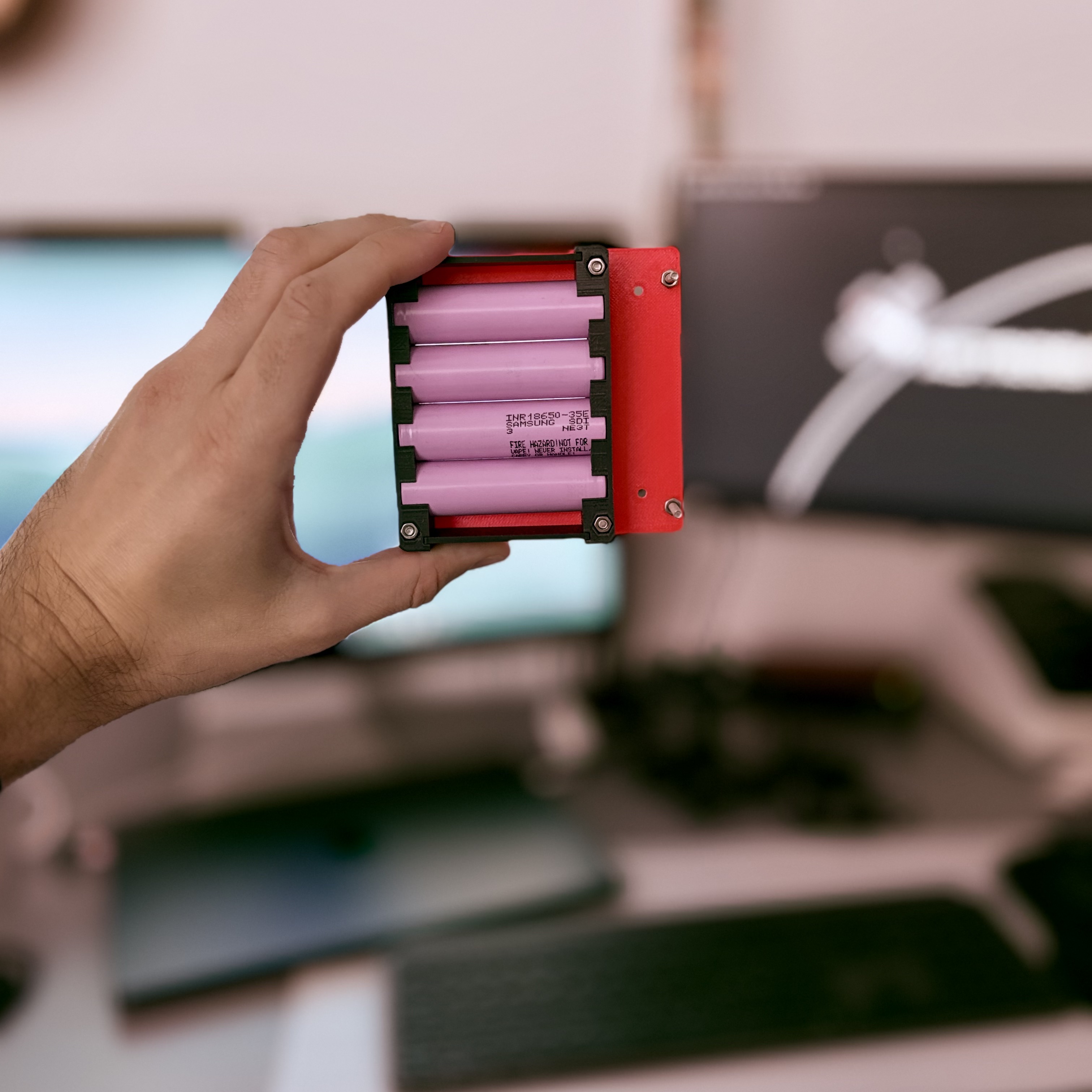
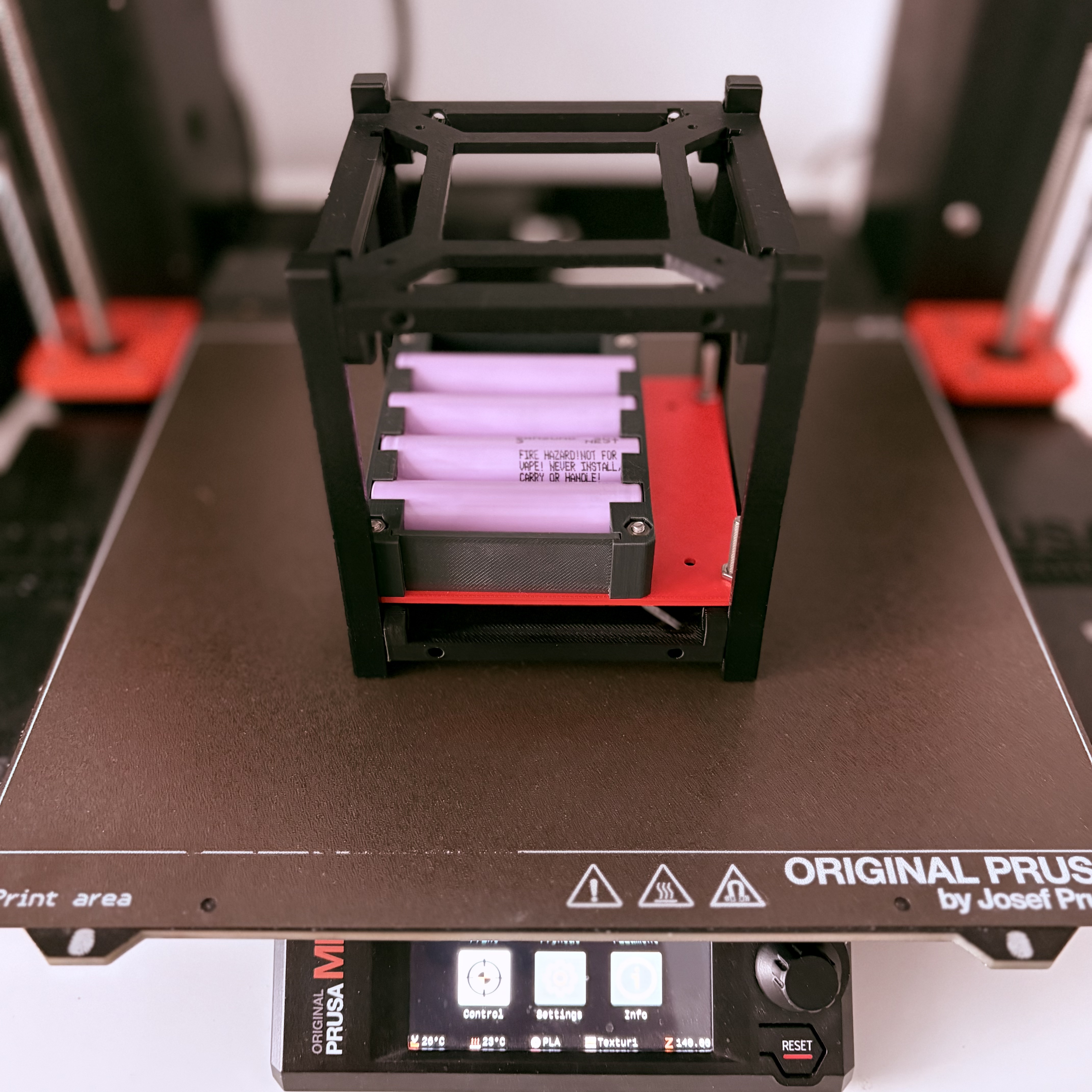
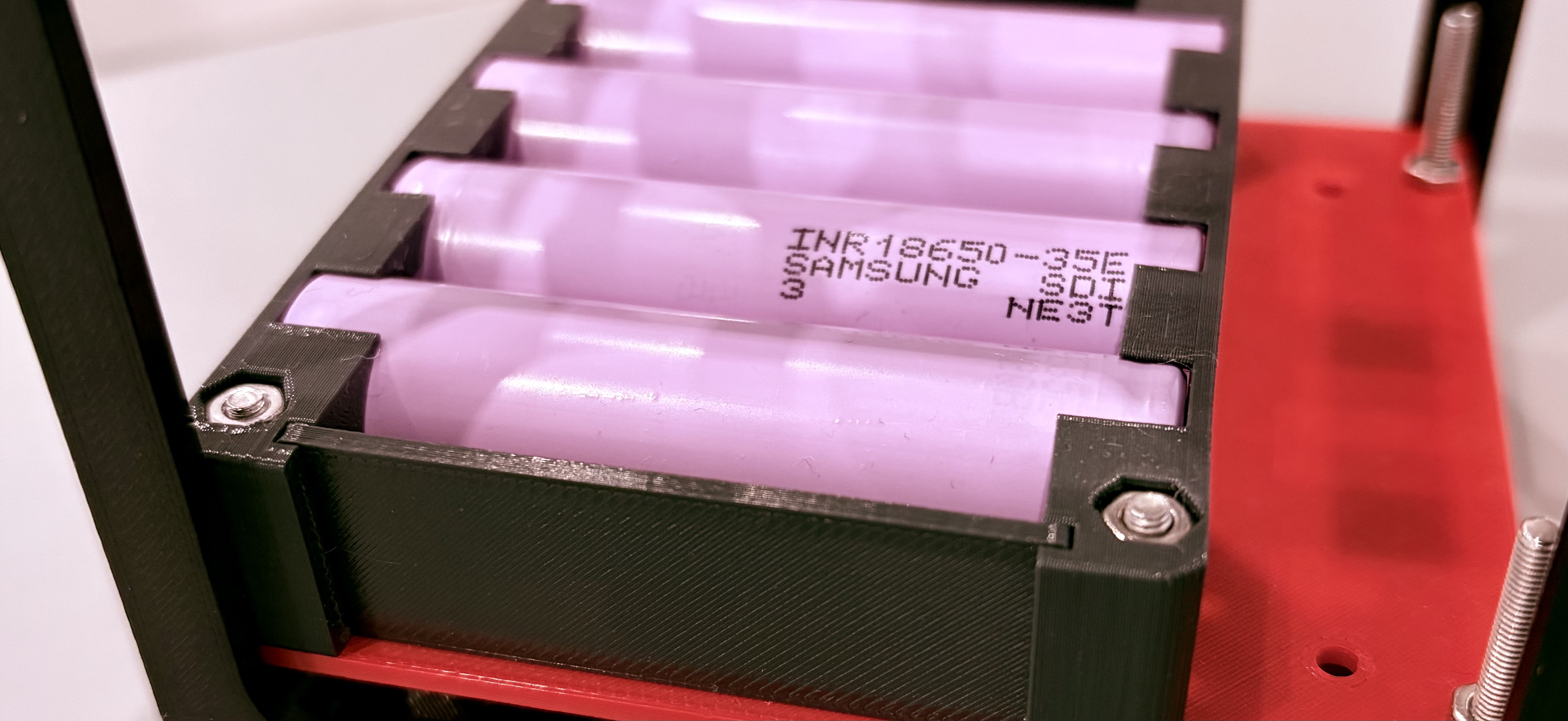
For this iteration of the platform, we selected Samsung INR18650-35E cells (NMC chemistry, 3500 mAh) and LG MJ0 18650 cells. Both are commercially available, well-characterized 18650-format NMC cells with a strong track record in demanding applications, which made them a sound starting point for our BMS development and qualification testing.
Why Energy Density Wins on a CubeSat
For a CubeSat, volume and mass budgets are brutally tight. Every cubic centimeter given to the battery is a cubic centimeter not available for payload, solar panels, or structure. Li-ion’s higher energy density means we can hit our power budget with a smaller, lighter pack — which matters when the whole spacecraft might be a handful of units.
This is a big part of why our DIOO BMS design centers on a 2S2P Li-ion configuration: two cells in series to reach the bus voltage we need, and two parallel strings for both capacity and redundancy. If Li-ion didn’t offer the energy density it does, hitting our voltage and capacity targets in the available volume would have been far harder.
Cylindrical vs. Flat (Pouch) Cells
Chemistry aside, cell format is its own important decision. Cylindrical cells (like the 18650 format we’re using) have a rigid metal can, which gives them mechanical robustness, well-controlled venting behavior in a fault condition, and a very mature, standardized manufacturing base — there’s a huge ecosystem of tooling, holders, and data built around formats like 18650 and 21700. The trade-off is that cylinders pack less efficiently into a rectangular volume, leaving gaps that pouch cells wouldn’t.
Flat (pouch) cells use a flexible foil enclosure instead of a rigid can. They pack more efficiently into flat spaces, can be shaped to fit unusual geometries, and often have a slight edge in gravimetric energy density since they’re not carrying a metal can. But that same flexible enclosure is more vulnerable to punctures and swelling, and pouch cells generally need more careful mechanical support and a more customized restraint structure to survive launch loads safely.
For a CubeSat structure, the rigidity and flight heritage of cylindrical cells tipped the balance in their favor for us, but it’s a decision that depends heavily on the specific bus geometry a mission is working with.
Testing, Filtering, and Welding: The Unglamorous Part That Matters Most
Choosing the right chemistry and format is only the first step. Even cells from a reputable manufacturer, from the same batch, vary from unit to unit — and for a mission where you can’t send a technician up to swap a bad cell, that variance has to be caught on the ground.
Before any cell goes into a flight pack, we run it through a battery of characterization tests:
- Internal resistance (ohm) testing to catch cells with abnormally high internal resistance, which points to manufacturing defects or degraded performance.
- Full charge/discharge cycle testing to verify actual capacity against the datasheet rating and to observe how a cell behaves over repeated cycles before it’s ever flown.
- Load testing under realistic current draw to confirm the cell holds up under the discharge profile the mission will actually demand.
Only cells that fall within a tight statistical band on all of these metrics get matched together into strings — a process often called binning or filtering. Pairing a slightly weak cell with a slightly strong one in the same series or parallel group creates imbalance that fights against everything the balancing circuitry is trying to do, so this filtering step directly protects the effectiveness of the balancing protection architecture.
Finally, how the cells are physically joined matters just as much as which cells you chose. Cylindrical cells should never be soldered directly — the sustained heat from a soldering iron can damage the internal separator and safety vents, degrading the cell or creating a latent failure that might not show up until it’s flying. That’s why we join cells using a dedicated spot welder designed for battery assembly, which delivers a very short, precisely controlled pulse of current through thin nickel or nickel-plated steel strips, bonding them to the cell terminals without meaningfully heating the cell itself.
The Trade-off: Safety and Complexity
Li-ion isn’t free of downsides, and it would be dishonest to pretend otherwise. Li-ion cells are more sensitive to overcharge, over-discharge, and thermal extremes than NiCd or NiMH. Push a Li-ion cell outside its safe operating window and you risk thermal runaway — a real concern in the vacuum of space, where there’s no convective cooling to carry heat away.
That’s precisely why the protection architecture around the cells matters as much as the cell choice itself. In our design, this is where the balancing and protection ICs come in — one per string, handling cell balancing and providing the first line of defense against overvoltage and overcurrent conditions. Layered on top of that, we keep temperature, current, and voltage monitoring separate per string so a fault on one string doesn’t mask a problem on the other, and we treat fuses (and pyro-fuses on next phase implementation) as the final, irreversible backstop if the earlier protection layers are ever defeated.
In other words: Li-ion buys you performance, but it obligates you to build a more careful protection system around it. That’s a trade we were willing to make, because the alternative — an older, “safer by default” chemistry — would have cost us mass and volume we simply don’t have to spare.
Redundancy Without Compromise
One of the nice side effects of choosing Li-ion is that the cells themselves are small and light enough that building in real redundancy doesn’t blow the budget. Our 2S2P layout means we can isolate or power down a degraded string independently, using it as a backup rather than losing the mission if one string develops a fault. Per-string protection and control from our monitoring MCU gives housekeeping software the ability to make that call autonomously — something that would be a much heavier lift with a bulkier, lower-density chemistry.
The Bottom Line
We chose Li-ion — specifically NMC cells — for Astro-Bat’s DIOO battery system because it gives us the best available balance of energy density, mass, and flight-proven maturity for a small satellite platform, provided we invest properly in cell selection, testing, assembly, and the protection architecture around it. NiCd and NiMH offer simplicity and heritage, but at a mass and volume cost we can’t absorb. Li-ion, backed by careful cell filtering, proper spot-welded assembly, dedicated protection and balancing ICs, per-string monitoring, and a layered fuse strategy, lets us fly lighter without flying riskier.
It’s not a decision we made lightly, but it’s one we’re confident in — and it’s shaping every layer of the BMS we’re building next.
References
-
NASA Ames Research Center, Small Spacecraft Systems Virtual Institute (S3VI). State-of-the-Art of Small Spacecraft Technology: Chapter 3, Power. NASA. Updated annually (2026 edition published May 2026). Available at: https://www.nasa.gov/smallsat-institute/sst-soa/power-subsystems (accessed 23 October 2026).
-
Buchmann, I. (Cadex Electronics Inc.). BU-205: Types of Lithium-ion. Battery University. n.d. (continuously updated). Available at: https://batteryuniversity.com/article/bu-205-types-of-lithium-ion (accessed 23 October 2026).
-
Samsung SDI Co., Ltd., Cylindrical Cell Development Group, Energy Business Division. Technical Report of INR18650-35E. June 2015. Available at: https://static.rapidonline.com/pdf/10-5181_v1.pdf (accessed 23 October 2026).
-
LG Chem. Product Specification: Rechargeable Lithium Ion Battery, Model INR18650 MJ1 3500mAh. Document LRB-PS-CY3500_MJ1, Rev. 1. 30 June 2016. Available at: https://www.mikrocontroller.net/attachment/667554/30708_datasheet.pdf (accessed 23 October 2026).
-
Lygte-info.dk. Samsung INR18650-35E 3500mAh (Pink): Battery Test Review. n.d. Available at: https://lygte-info.dk/review/batteries2012/Samsung%20INR18650-35E%203500mAh%20%28Pink%29%20UK.html (accessed 23 October 2026).
-
Texas Instruments. bq2920x Voltage Protection with Automatic Cell Balance for 2-Series Cell Li-Ion Batteries. Datasheet SLUSA52C, September 2010, revised March 2016. Available at: https://www.ti.com/document-viewer/BQ29209/datasheet (accessed 23 October 2026).