
· AstroBAT Team · 4 min read
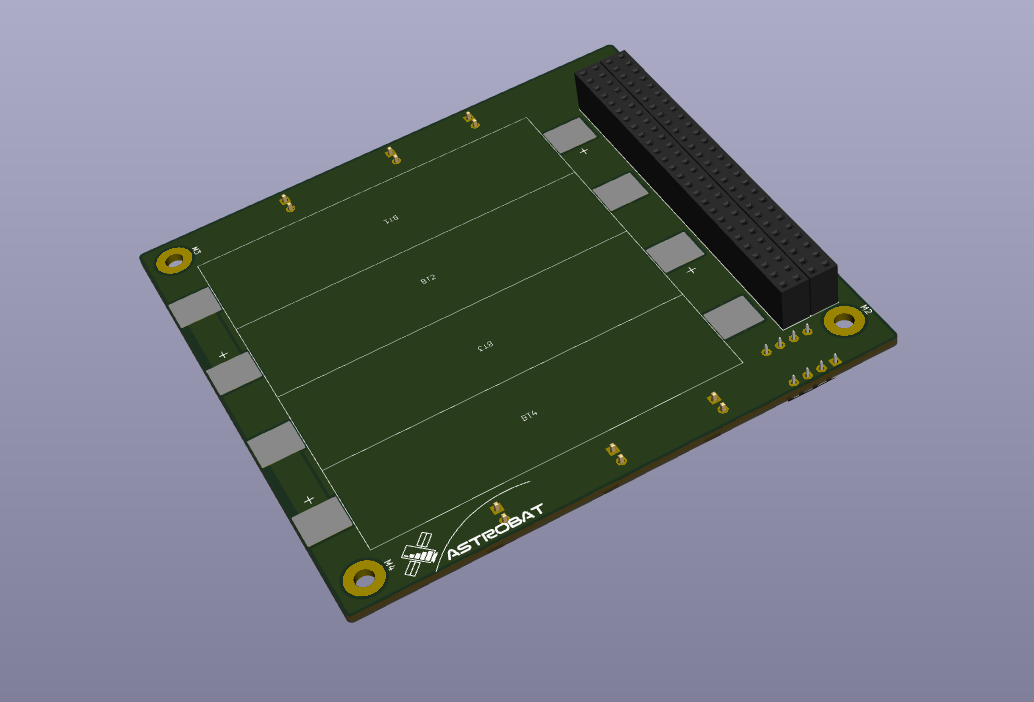
Space battery engineering challenges: Why a battery in orbit is not the same as a battery on Earth
If you've ever left your phone in a hot car, you already have a feel for how temperature affects a Li-ion battery. Now imagine that same battery going from -20°C to +40°C every 45 minutes (in worst case scenario from -40°C to +85°C), thousands of times a year, while also being bombarded by high-energy particles — and never getting a chance to be serviced or replaced. That's the everyday reality for a battery pack in Low Earth Orbit (LEO).
At AstroBAT, this is the exact problem we're solving with our satellite battery pack, DIOO. Here's why it's such a different engineering challenge than building a battery for a car, a laptop, or even a terrestrial backup power system.
1. The Thermal Rollercoaster of LEO
A satellite in LEO (around 400–600 km altitude) circles the Earth roughly every 90 minutes — passing in and out of sunlight on every single orbit. That means the spacecraft (and its battery) swings between direct solar heating and the deep cold of eclipse, over and over, thousands of times across a mission's lifetime.
Unlike a phone battery that experiences a handful of thermal cycles per day, a LEO battery pack can rack up more thermal cycles in a single week than a consumer battery sees in years. Each cycle causes tiny amounts of mechanical stress on cell materials. Over a multi-year mission, that adds up — so thermal management and cell selection have to be designed around cycle life, not just capacity.
2. Radiation: The Enemy You Can't See
Outside Earth's protective atmosphere, spacecraft electronics are exposed to energetic particles from cosmic rays and solar activity. One especially well-known trouble spot is the South Atlantic Anomaly (SAA) — a region where the Van Allen radiation belt dips unusually close to Earth, exposing satellites passing through it to elevated radiation levels.
This matters most for the electronics, not the battery cells themselves. A Battery Management System (BMS) is built from sensitive semiconductors, and radiation can cause anything from subtle sensor errors to full circuit lock-ups (a "latch-up" event). Designing radiation-tolerant BMS electronics means choosing components carefully, adding redundancy, and building in fault detection so the system can recover — or fail safely — without help from the ground.
3. No Repair Trucks in Orbit
On Earth, if a battery system misbehaves, someone can walk over and reset it, swap a fuse, or replace the pack entirely. In orbit, there is no service visit. Every fault mode has to be anticipated, tested, and designed around before launch.
That's why intelligence at the cell level matters so much:
- Cell-level monitoring catches problems (like unusual voltage or temperature drift) before they escalate.
- Active balancing keeps individual cells working within safe limits relative to each other, extending pack life.
- Redundant protection circuits ensure that a single component failure doesn't take down the whole power system.
- Real-time telemetry feeds data back to the spacecraft's onboard computer, so ground teams always know the health of the battery — even from hundreds of kilometers away.
4. Power Budgets Are Brutally Tight
Every gram and every milliwatt matters on a spacecraft. Solar panels can only generate a fixed amount of power, and that power has to cover propulsion, communications, payload instruments, and life support for the battery itself. A battery pack for LEO has to be engineered for high energy density without compromising the safety margins that space missions demand — a very different balancing act than a terrestrial battery, where extra weight or volume is a much smaller concern.
5. Qualification: Proving It Before It Flies
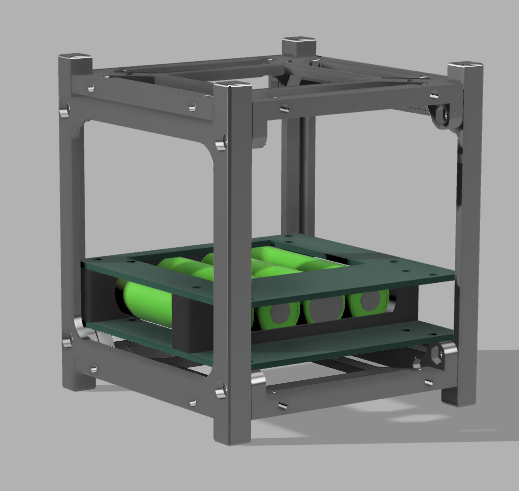
Because there's no fixing a battery once it's in orbit, space hardware goes through a rigorous qualification path before launch — vibration testing (to survive the rocket ride), thermal-vacuum testing (to simulate the orbital environment), and radiation testing (to verify tolerance to the space environment). This is a structured, staged process, and it's a core part of how we're developing DIOO under ESA BIC Slovakia guidance — building toward flight-readiness step by step rather than all at once.
The Bottom Line
A satellite battery isn't just a bigger, tougher version of the one in your phone — it's a fundamentally different engineering problem. Thermal cycling, radiation, zero-maintenance operation, and strict power budgets all combine to demand a purpose-built approach from day one.
That's exactly the challenge we're tackling with DIOO, and we'll be sharing more technical deep-dives as the project moves through prototyping and toward qualification. Stay tuned.