
· Peter Szeles · 8 min read

From TRL 1 to TRL 9: Our Qualification Roadmap
Technology readiness levels explained through DIOO, the astro-bat battery pack. DIOO’s current TRL is 3: levels 1 and 2 are behind us, level 3 is the work in front of us.
If you have ever talked to a space agency, a launch provider or a CubeSat team, you have heard the question: “What is the TRL?” It is a short question, and the honest answer says a lot about how far a product really is from flying. In this post we explain what technology readiness levels are, and then we use our own DIOO battery pack to show, level by level, what it takes to climb from a promising idea to hardware that has already flown.
You can follow the climb live: the DIOO project page carries a TRL track that shows every level, which ones we have evidenced, and which one we are working on.
What is a TRL?
Technology Readiness Levels are a nine-point scale, originally developed at NASA and later adopted by ESA and the wider space industry, that describes how mature a technology is. TRL 1 is a basic idea on paper. TRL 9 is a system that has successfully flown and operated in its real mission. Everything in between is a series of increasingly demanding proofs.
The scale matters because space hardware is unforgiving. You cannot open the box after launch. A TRL is a shared language that tells a mission team how much risk they inherit when they put your product on their satellite.
In short:
- TRL 1-2: Basic principles observed, concept formulated.
- TRL 3: Proof of concept: the core idea is shown to work, analytically or experimentally. This is where DIOO is today.
- TRL 4: Breadboard validated in the laboratory.
- TRL 5: Breadboard validated in a relevant environment.
- TRL 6: Prototype demonstrated in a relevant environment.
- TRL 7: Prototype demonstrated in space.
- TRL 8: Flight model qualified and accepted.
- TRL 9: Flight proven through successful mission operations.
Meet DIOO battery subsystem
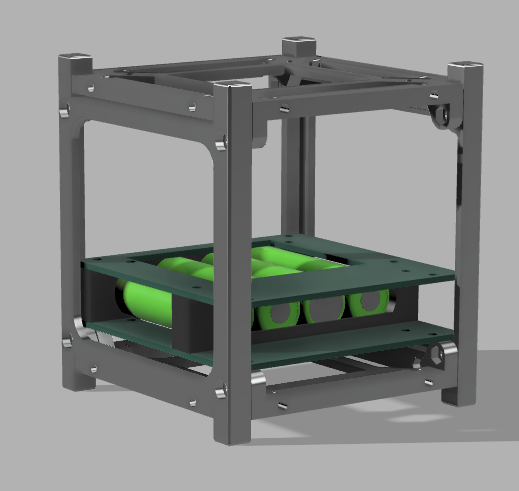
DIOO is the battery pack we are developing at astro-bat.com for CubeSats. Its current form is a mechanical prototype with PC104 dimensions: four 18650 battery cells held in a 3D-printed frame, with a mounting plate that follows the PC104 footprint, so we can check fit, cell arrangement and assembly well before the electronics are final. In parallel, the first electronics board, DIOO Battery pack v1.0, is being designed in KiCad and prototyped in-house.
Where DIOO stands today
DIOO’s current TRL is 3. TRL 1 and TRL 2 are attained and evidenced, TRL 3 is in progress, and TRL 4 is the next target.
Honesty about TRL is a feature, not a weakness. Being at the early end of the scale is not a confession, it is a statement a customer can check. The basic principles are observed and reported, the concept and its application are formulated, and the mechanical envelope exists in hardware while the first electronics revision is being laid out. What we have not yet done is demonstrate a complete, working pack across its operating range in a laboratory — that is TRL 4.
The roadmap, level by level
TRL 1: Basic principles — attained
What it means: the underlying basic and innovation principles are observed and reported.
For DIOO this is the innovation idea: lithium-ion cell behaviour under radiation and thermal load, and the failure modes a CubeSat power subsystem has to survive. It is written up in the ESA BIC application and the DIOO concept paper. The principles are well known, and that is exactly why the level exists: it says we are not guessing.
TRL 2: Technology concept — attained
What it means: a specific concept and its application are formulated.
This is where a general idea becomes a product definition. We documented the CubeSat power-subsystem gap, sized the mission requirements, and selected the cells and the PC104 form factor that DIOO would use. The ESA BIC Slovakia grant and the project kick-off both sit at this level, as does the market and concept analysis that finished in Q3 2026.
TRL 3: Proof of concept — in progress
Question we must answer: does the core idea work at all?
For DIOO that means showing that the cell arrangement, the mechanical frame and the first electronics revision can come together into something that charges, discharges and protects the cells as intended. At this stage we favour fast, cheap iterations. The goal is learning, not polish. Requirements and architecture documentation are the current work, and the 4-cell 18650 frame with the PC104 mounting plate is the physical evidence.
TRL 4: Laboratory breadboard
Question we must answer: does it work as a complete function, in the lab?
Here the pack operates end to end on the bench. We characterise the cells before they are ever assembled: internal resistance, capacity and cycle behaviour, with matching and filtering of cells so that only well-balanced cells share a pack. Cells are joined with a dedicated spot welder, not solder, because joint quality is a safety topic. We test the protection and monitoring functions, behaviour under load and the effect of low temperature on charging. We also close out the layout of the electronics so that what we test is a real design, not a collection of workarounds.
TRL 5: Relevant environment, breadboard
Question we must answer: does it keep working when conditions start to resemble space?
The key phrase is “relevant environment.” For a CubeSat battery that means thermal cycling across the expected temperature range, operation in vacuum, and early vibration tests. We expect to find weaknesses here, and that is the point: every failure found on the ground is one we do not meet in orbit.
TRL 6: Representative prototype in a relevant environment
Question we must answer: does a near-final design survive the environment, with its interfaces?
This is a major step. The prototype here is close to the real product in form, fit and function, with PC104-compatible mechanics, final-intent electronics and the interfaces a customer’s satellite will actually use. It goes through the full relevant-environment campaign: thermal vacuum, vibration and shock at levels set by launch provider requirements, and abuse and safety testing such as short-circuit and over- and under-voltage cases. For lithium-ion packs, demonstrating safe behaviour under fault conditions is as important as demonstrating performance.
TRL 7: Demonstration in space
Question we must answer: does it work in orbit?
No ground test fully replaces flight. TRL 7 requires the prototype to fly, typically as a secondary payload or as a subsystem on a partner’s mission. This is also where partnerships matter most: we are interested in teams who would like to fly a DIOO pack and share telemetry with us. In return, they get a battery pack whose development they can follow in detail.
TRL 8: Qualified flight hardware
Question we must answer: is the flight design proven, and is each unit built the same way?
TRL 8 combines a successful flight demonstration with a completed qualification and acceptance programme. The design is frozen. Manufacturing, cell screening, welding and inspection processes are documented so that every flight unit can be traced and compared with the qualified one. Acceptance testing of each unit confirms that it is a faithful copy.
TRL 9: Flight proven
Question we must answer: does it work in real missions, repeatedly?
TRL 9 is earned through operations, not paperwork: the pack has delivered power throughout a real mission. Each additional mission adds heritage, and heritage is what lowers risk for the next customer.
What we have learned about TRLs
A TRL is a claim that needs evidence. Anyone can write “TRL 6” in a brochure. The useful version points to test reports, conditions and results.
Components are not systems. A cell with flight heritage does not give a pack flight heritage. Mechanics, wiring, welding, protection electronics and the thermal design all have to be proven together.
Most of the work is in the middle. The jump from TRL 3 to TRL 5 sounds small on the scale, but it is where design is turned into a product and where most surprises appear.
Follow the journey
We will update this roadmap as DIOO moves up the scale and will publish test results as we go. The DIOO project page now has a TRL track that lists all nine levels with the evidence we have for each one, so you can see exactly where the pack stands and what is next. If you are building a CubeSat and want to know more about DIOO, or you would like to discuss a flight demonstration, get in touch through astro-bat.com.